
Testing Standards for UAV Parachute Recovery Systems

Unmanned Aerial Vehicle (UAV) parachute recovery systems are no longer considered optional safety accessories for many professional operations. For industrial, governmental, and defense-related UAV deployments, recovery systems are often treated as mission-critical safety components. Their performance directly affects aircraft survivability, third-party risk mitigation, and regulatory compliance.
Testing standards play a central role in determining whether a UAV parachute recovery system is suitable for operational deployment. Buyers and procurement teams rely on structured testing frameworks to verify deployment reliability, environmental resilience, system integration, and lifecycle durability. Unlike consumer-grade accessories, UAV recovery systems must function under unpredictable and often hostile conditions, making standardized testing a foundational requirement rather than a formality.
This article outlines how testing standards are applied to UAV parachute recovery systems, what buyers should examine during qualification, and how testing data informs procurement decisions.
Scope of Testing for UAV Parachute Recovery Systems
Testing standards for UAV parachute recovery systems are typically multi-layered, covering both component-level and system-level validation. Buyers should understand that no single test can confirm system readiness; rather, qualification depends on cumulative evidence across several testing categories.
Core testing domains usually include:
Mechanical deployment reliability
Sensor and trigger accuracy
Environmental resistance
Integration compatibility
Repeatability and failure tolerance
Maintenance and lifecycle endurance
Each domain addresses different operational risks and failure modes that may emerge during real-world UAV missions.
Deployment Reliability Testing
Static Deployment Tests
Static deployment testing focuses on verifying that the parachute can be released and fully deployed under controlled conditions. These tests evaluate:
Actuator response time
Parachute extraction force
Line release behavior
Canopy inflation symmetry
Buyers typically review test results that demonstrate consistent deployment across repeated cycles, confirming that mechanical fatigue or minor assembly variations do not compromise system behavior.
Dynamic Deployment Tests
Dynamic tests simulate in-flight conditions, including:
Various airspeeds
Different UAV attitudes (level, descending, tumbling)
Partial power or complete power loss scenarios
Dynamic deployment reliability is often the most critical data point for procurement teams, as it reflects real operational risk rather than laboratory assumptions.

Triggering and Sensor Validation
Autonomous Trigger Logic Testing
Most UAV parachute recovery systems rely on onboard sensors to detect abnormal flight conditions. Testing standards examine how accurately these sensors identify:
Free-fall conditions
Excessive angular velocity
Structural failure indicators
Loss of propulsion or control signals
False positives and false negatives are both unacceptable in professional UAV operations. Buyers should expect test documentation that quantifies trigger thresholds and explains how the system differentiates between aggressive maneuvers and genuine emergencies.
Manual Override Verification
For certain mission profiles, manual triggering remains a requirement. Testing standards should confirm:
Trigger responsiveness under load
Signal integrity during partial system failures
Human-machine interface reliability
This is especially relevant for training platforms and experimental UAV programs.
Environmental Testing Standards
Temperature and Humidity Exposure
UAV recovery systems are frequently exposed to extreme temperatures and humidity levels, particularly in industrial inspection, border patrol, and maritime environments. Environmental testing typically includes:
High-temperature storage and operation
Low-temperature deployment tests
Humidity cycling and condensation exposure
Buyers should confirm that parachute materials, electronic components, and pyrotechnic or mechanical actuators maintain performance across specified environmental ranges.
Dust, Sand, and Particulate Resistance
In desert, mining, and construction applications, airborne particulates present a major risk. Testing standards may include:
Dust ingress resistance
Sand abrasion exposure
Post-contamination deployment verification
These tests assess whether contamination affects canopy extraction, sensor accuracy, or actuator reliability.
Structural Load and Descent Performance Testing
Load Capacity Verification
Testing standards require recovery systems to demonstrate consistent performance under defined payload weights. This includes:
Maximum certified takeoff weight
Uneven load distribution scenarios
Partial system degradation cases
Buyers should examine test data that correlates descent rate with payload mass, ensuring that impact energy remains within acceptable limits.
Descent Stability Evaluation
A controlled descent is as important as successful deployment. Testing standards often evaluate:
Oscillation behavior
Descent rate consistency
Canopy stability in turbulent air
Unstable descent profiles can introduce secondary risks, particularly in urban or infrastructure-dense environments.
Integration and Compatibility Testing
Airframe Integration Validation
UAV parachute recovery systems must be compatible with a wide range of airframes. Testing standards may include:
Mounting stress analysis
Center-of-gravity impact evaluation
Structural interference checks
Integration testing ensures that the recovery system does not introduce new failure modes into the UAV platform.
Avionics and Power Interface Testing
Electronic integration testing verifies:
Power draw stability
Signal redundancy
Compatibility with flight controllers and telemetry systems
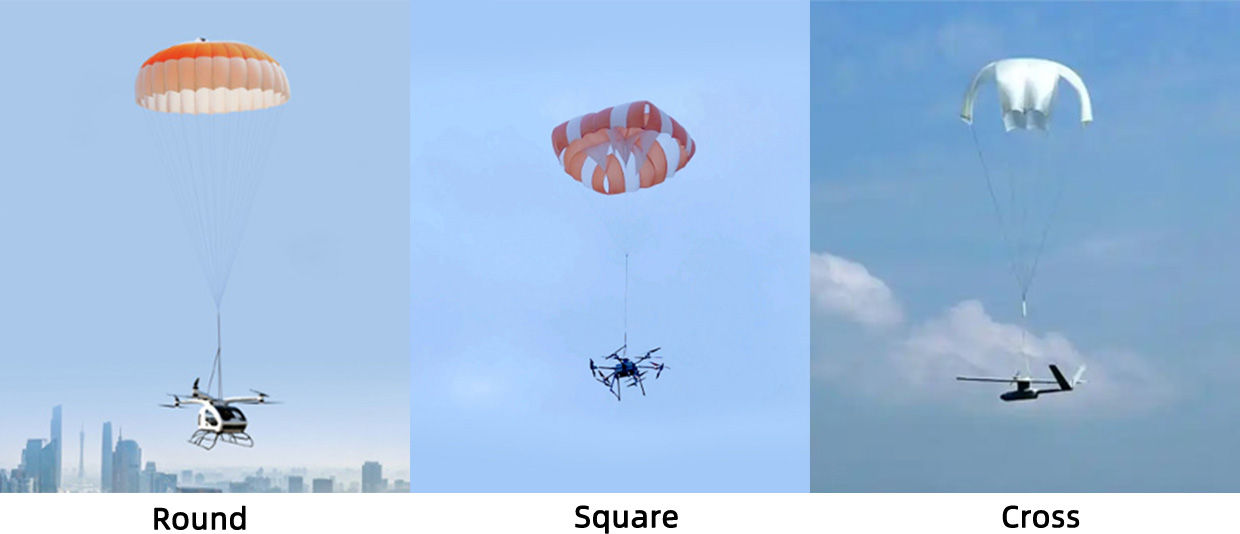
Buyers should confirm that recovery systems operate independently of primary flight control systems wherever possible, reducing cascading failure risks.
Redundancy and Failure Mode Testing
Single-Point Failure Analysis
Testing standards often require documentation showing how the system behaves when individual components fail. This may include:
Sensor failure simulations
Partial actuator malfunction tests
Power interruption scenarios
A robust recovery system should fail safely rather than fail silently.
Redundant Activation Pathways
Some advanced systems incorporate multiple triggering mechanisms. Testing standards should verify that:
Redundant systems operate independently
Backup activation does not interfere with primary logic
Redundancy does not increase false activation risk
This type of testing is particularly relevant for high-value UAV platforms.
Endurance and Lifecycle Testing
Repeated Deployment Cycles
Lifecycle testing evaluates how many deployments a system can perform before performance degradation occurs. Buyers typically review:
Deployment cycle limits
Maintenance intervals
Component replacement thresholds
These data points inform total cost of ownership calculations.
Long-Term Storage and Aging Tests
Recovery systems may remain unused for extended periods. Testing standards often include:
Material aging simulations
Seal and packaging degradation assessments
Post-storage deployment verification
This ensures reliability even after prolonged storage.
Documentation and Traceability Requirements
Testing standards are only meaningful if results are properly documented. Buyers should expect:
Test protocols and methodologies
Raw and summarized test data
Revision-controlled test reports
Component traceability records
In institutional procurement contexts, documentation quality is often weighted as heavily as technical performance.
Some manufacturers, such as Nanjing Hongguang General Aviation Equipment Technology Co., Ltd., reference structured testing documentation as part of their system qualification disclosures, reflecting broader industry expectations rather than marketing differentiation.
Buyer Considerations When Reviewing Testing Standards
When evaluating UAV parachute recovery systems, procurement teams should consider:
Whether testing conditions realistically reflect operational environments
If failure scenarios are explicitly documented
How test results translate into operational limitations
Whether independent or third-party testing is available
How testing data supports regulatory or internal safety approval processes
Testing standards should reduce uncertainty, not obscure it.
Testing standards for UAV parachute recovery systems form the foundation of safe and responsible UAV operations. For professional buyers, testing is not about achieving certification labels but about understanding system behavior under stress, failure, and long-term use.
Well-documented, comprehensive testing enables informed procurement decisions, supports internal risk assessments, and contributes to safer airspace integration. As UAV operations continue to expand into complex environments, rigorous testing standards will remain a defining factor in recovery system qualification and deployment readiness.


