
Tactical Backpack Accessories: Must-Have Gear for Your Pack
Accessories that earn their weight
A tactical backpack is built to carry morethan what fits in its main compartment alone. The right add-ons turn a 25-literpack into a day-long workstation, a range bag, or a travel rig without buying asecond pack. The wrong ones add bulk and weight you'll strip off after oneouting.
This piece runs through the accessoriesthat actually get used — based on what sticks around on a pack after a month ofdaily carry, not what looks sharp in a product photo.
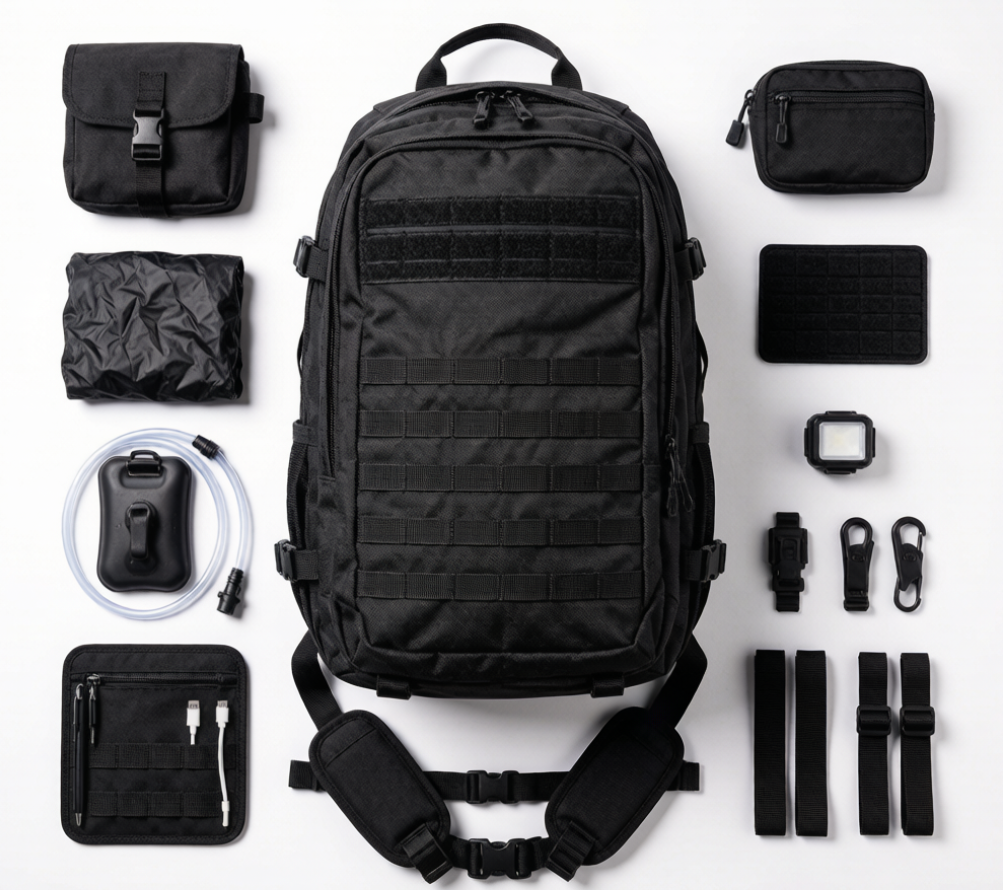
MOLLE pouches: the attach-anywhere workhorses
MOLLE (Modular Lightweight Load-carryingEquipment) is a webbing grid sewn onto the outside of the pack. Pouches withmatching straps weave through the grid and lock in place. It's the attachmentstandard on almost every tactical pack, and for good reason — it lets youreconfigure the exterior layout to fit the day's load.
The most useful sizes are a compact utilitypouch for med kits or tools, a medium general-purpose pouch for snacks andspare batteries, and a taller admin pouch for pens, notepads, and cables. A setof two or three covers 90% of use cases.
Look for pouches with drainage grommets atthe bottom. If a water bottle leaks or rain gets in, you want the water todrain out, not pool inside and soak the contents. For med kits or electronics,a pouch with a loop field on the front lets you attach ID patches orhook-backed organizers inside.
Hydration bladders: water where you can reach it
A hydration bladder slides into the pack'sdedicated sleeve and routes a drinking tube over the shoulder strap. You drinkby biting the valve, without taking the pack off. For range days, long hikes,or any activity where stopping to grab a bottle breaks your rhythm, this is thesingle biggest quality-of-life upgrade you can make.
Bladders come in 1.5-liter, 2-liter, and3-liter sizes. A 2-liter bladder is the sweet spot — it fits most 20L-35L packswithout eating too much internal volume, and it's enough water for 3-4 hours ofactivity in moderate heat.
The wide-opening top style (sometimescalled a clamshell or slide-top) is worth the extra few dollars. It's mucheasier to fill, clean, and dry than the narrow screw-cap type. A bladder that'shard to dry grows mold fast, and once that happens it's nearly impossible toget the taste out.
Insulated tube sleeves stop the water inthe drinking tube from heating up under direct sun and freezing in coldweather. If you train outdoors year-round, get one.
Rain covers: the cheapest insurance
A form-fitting rain cover stored in adedicated bottom pocket costs under twenty dollars for most pack sizes. When astorm hits, you pull it out, stretch the elastic hem over the pack, and cinchthe drawcord. The pack stays dry without any permanent change to the packitself.
A rain cover should fit the pack when fullyloaded. Buy a size that matches your pack's liter capacity as listed by themanufacturer. The cover should have a drawcord closure and a clip that goesaround the pack body so wind doesn't peel it off. Reflective strips on thecover are useful if you're on a road at night, but they're not mandatory.
For packs that live in wet conditions, aseam-taped rain cover with a hydrostatic head rating of 2000mm or higher addsmeaningful protection over a basic PU-coated nylon cover. The price differenceis ten to fifteen dollars for most sizes.
Shoulder strap pads and sternum straps
Factory shoulder straps on mid-tier packsare fine at 5-6 kg. Push the load to 10 kg or wear the pack for 5+ hours, andpressure points start to show up at the collarbone and the top of the shoulder.
Slip-on shoulder pads — dense EVA foam witha mesh cover — spread the load over a wider area and add about 80 grams perside. They're removable, so you can leave them off on light days.
A sternum strap clips the two shoulderstraps together across the chest. It stops the straps from sliding outward whenthe pack is heavy or when you're moving fast. Most packs include one, but ifyours doesn't, aftermarket sternum straps with a quick-release buckle arewidely available and install in under a minute. The tension should beadjustable — not just clipped at one fixed length.
Organization panels and admin inserts
If the pack's internal organization is asingle big pocket plus one mesh zip, an admin insert panel fixes that. Theseare flat panels with elastic loops, zippered mesh pockets, and sometimes a keyclip. You load it with pens, cables, a multitool, and a small notebook, thendrop the whole panel into the main compartment. When you switch packs, theentire organization moves with you.
Hook-backed panels designed to adhere toloop-lined interiors are a cleaner option if the pack supports them. They stayflat and don't shift around inside the pack.
Lighting and visibility
A small LED light clipped to the outside ofthe pack — on a shoulder strap MOLLE column or a daisy chain — is useful forthree things: finding gear inside the pack at night, being seen on a roadshoulder after dark, and signaling in an emergency. A light with a red modepreserves night vision.
A roll of reflective tape or a fewreflective patches on the back of the pack is cheaper than a light and neverruns out of batteries. For anyone who walks or bikes with a pack after dark,this is a five-dollar upgrade that makes a real difference.
Carabiner clips and attachment points
A locking carabiner clipped to the pack'sgrab handle or a shoulder strap D-ring gives you a place to hang wet gloves, ahat, or a rolled-up jacket on the outside of the pack. It also serves as aquick-attach point for a small dry bag or a shoe bag.
Non-locking wire-gate carabiners arelighter but can open accidentally when scraped against a door frame or avehicle. For anything you care about not losing, use a locking gate.
What to add first
If you're starting from a bare pack, thepriority order is: a hydration bladder, a rain cover, and one or two MOLLEpouches. Those three cover water access, weather protection, and externalorganization — about 80% of what accessories actually solve. Everything elsecan wait until you know what you need.


