
How Parachutes Are Tested: Quality Standards and Drop-Test Requirements

Parachute reliability depends not only on design and materials, but also on strict testing and quality control procedures. Before a professional parachute system is approved for use in sports, training, military, or aviation applications, it must undergo multiple levels of inspection and drop testing to verify performance under real-world conditions.
This article explains how parachutes are tested, what quality standards apply, and why drop-test requirements are critical to ensuring safe and consistent deployment.
1. Why Parachute Testing Is Essential
Parachutes are life-critical systems. Unlike many mechanical components, a parachute may remain unused for extended periods and must still perform perfectly when deployed.
Testing ensures:
Reliable canopy inflation
Structural integrity under load
Predictable descent behavior
Compliance with safety standards
Without rigorous testing, even high-quality materials cannot guarantee operational safety.
2. Quality Standards Governing Parachute Manufacturing
Professional parachutes are manufactured under structured quality management systems, often including:
ISO 9001 quality management standards
Internal military or aviation technical specifications
Customer-specific testing protocols
These standards define:
Material traceability
Process control
Inspection procedures
Documentation and certification
Manufacturers must demonstrate repeatable production quality, not just one-time performance.
3. Material Testing Before Assembly
Before canopy fabrication begins, raw materials undergo detailed testing.
Fabric Testing
Tensile strength
Tear resistance
Air permeability
UV and aging resistance
Suspension Line Testing
Load capacity
Elongation under stress
Abrasion resistance
Hardware Testing
Buckles and connectors
Harness stitching strength
Corrosion resistance
Only materials that pass predefined thresholds are approved for assembly.
4. Structural and Assembly Inspections
During manufacturing, parachutes undergo multiple in-process inspections:
Stitch density and seam strength checks
Canopy panel alignment verification
Line routing and attachment inspection
Harness and container integration tests
These inspections prevent assembly errors that could compromise deployment.
5. Static Load Testing
Static load testing evaluates how the parachute system performs under sustained weight.
Simulates payload loads exceeding operational limits
Verifies canopy and line strength
Confirms harness integrity
Testing loads often exceed rated values to ensure sufficient safety margins.
6. Drop-Test Requirements Explained
Drop testing is one of the most critical stages in parachute validation.
6.1 Purpose of Drop Testing
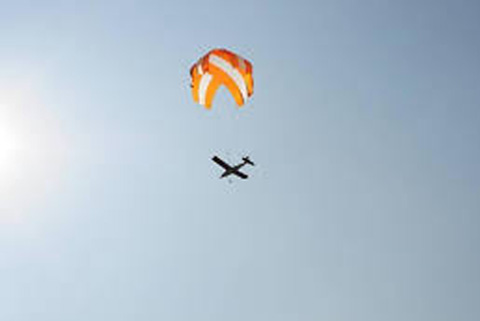
Drop tests simulate real deployment scenarios by releasing a parachute system from altitude or controlled platforms.
They evaluate:
Opening sequence
Inflation time
Descent rate
Stability during descent
Landing impact characteristics
6.2 Drop-Test Methods
Common methods include:
Aircraft-based deployment
Crane or tower drops
UAV-assisted release
Ballistic launch systems for high-speed testing
Each method is selected based on parachute type and application.
7. Environmental and Operational Condition Testing
Parachutes may be tested under various conditions:
High and low temperature environments
High humidity and rain simulation
Sand and dust exposure
Salt spray for marine operations
These tests confirm performance consistency in diverse climates.

8. Repeated Deployment and Fatigue Testing
Parachutes intended for training and repeated use must demonstrate durability.
Multiple deployment cycles
Line wear evaluation
Fabric fatigue analysis
This ensures performance does not degrade prematurely.
9. Documentation and Certification
After successful testing, manufacturers compile:
Test reports
Inspection records
Material certifications
Quality compliance documentation
Professional manufacturers such as Nanjing Hongguang General Aviation Equipment Technology Co., Ltd. integrate testing data into complete product traceability systems, supporting long-term quality assurance for both civil and specialized aviation parachute applications.
10. How Buyers Should Evaluate Test Compliance
When sourcing parachutes, buyers should verify:
Availability of drop-test reports
Load test data
Compliance with applicable aviation standards
Manufacturer testing capabilities
Transparent testing practices indicate manufacturing reliability and long-term support capability.
Parachute testing is a multi-layered process involving material inspection, structural validation, static load testing, and real-world drop tests. These procedures ensure that parachutes perform reliably when deployed, regardless of application or environment.
Understanding quality standards and drop-test requirements helps buyers, operators, and aviation professionals select parachute systems that meet safety expectations and regulatory demands. In professional aviation and sports environments, thorough testing is not optional—it is essential.


