
Parachute for Fixed-Wing UAV Recovery

Fixed-wing unmanned aerial vehicles (UAVs) are widely used for industrial surveying, mapping, long-endurance inspection, and scientific research missions. Unlike multirotor platforms, fixed-wing UAVs operate at higher horizontal speeds, carry heavier payloads, and often cover extended flight distances. These characteristics increase the risk of severe damage in the event of system failure.
Parachute recovery systems are one of the most effective solutions for fixed-wing UAVs. This technical guide explains the design, deployment principles, and operational considerations for fixed-wing UAV parachute systems.
Why Fixed-Wing UAVs Require Parachute Recovery
Fixed-wing UAVs are particularly vulnerable in emergency situations due to:
High horizontal velocity during flight
Limited maneuverability at low speed
Extended operational ranges far from safe landing zones
Heavier payloads compared to small multirotors
A properly engineered parachute system mitigates these risks by enabling controlled descent and reducing ground impact energy.
Core Design Considerations
1. Load Capacity
Parachutes must be rated for the UAV’s maximum takeoff weight, including:
Aircraft structure
Payload (cameras, LiDAR, sensors)
Battery or fuel mass
Exceeding load capacity can result in canopy tearing or line failure.
2. Deployment Dynamics
Fixed-wing UAVs often cruise at high horizontal speeds. The parachute system must accommodate:
Rapid canopy inflation under high airflow
Opening shock absorption
Stabilization of the UAV’s descent path
Deployment mechanisms may include ballistic or spring-assisted ejection systems.
3. Canopy Design
Round Canopies: Offer stable vertical descent
Cruciform Canopies: Reduce oscillation and spinning
Hybrid Designs: Combine stability and controlled drag for heavy UAVs
Proper canopy selection is essential for predictable recovery.
Deployment Mechanisms
Ballistic Deployment
Rapid extraction using pyrotechnic or compressed gas systems
Suitable for high-speed or high-altitude emergencies
Provides immediate canopy deployment
Spring-Assisted Deployment
Slower, controlled extraction
Reduces peak opening shock
Suitable for low-to-medium speed UAVs
Each method must be matched to flight speed, UAV mass, and mission profile.

Structural Integration
Parachute mounting requires careful engineering to:
Distribute opening forces across UAV airframe
Avoid interference with wings, propellers, and payloads
Maintain center-of-gravity alignment
Ensure minimal structural deformation during deployment
Failure to integrate correctly may compromise recovery reliability.
Deployment Altitude Requirements
Fixed-wing UAV parachutes require adequate altitude for:
Complete canopy inflation
Full shock absorption
Stabilized descent
Low-altitude emergencies may demand rapid inflation or hybrid recovery solutions to ensure safe landing.
Safety and Reliability
Fixed-wing UAV parachute systems improve operational safety by:
Reducing uncontrolled descent speed
Stabilizing flight attitude during failure
Protecting high-value payloads
Minimizing ground impact risk
Safety performance depends on:
Correct canopy sizing
Verified deployment speed range
Independent trigger logic
Repeated testing under representative conditions
Experienced manufacturers, such as Nanjing Hongguang General Aviation Equipment Technology Co., Ltd., provide validated systems for fixed-wing UAVs of varying sizes and payload classes.
Common Installation and Operational Mistakes
Selecting a parachute without considering horizontal cruise speed
Ignoring UAV mass variations between missions
Improperly routing suspension lines
Mounting container in obstructed locations
Failing to test under real flight conditions
Mitigating these mistakes ensures reliable emergency recovery performance.
Applications
Fixed-wing UAV parachute systems are widely used in:
Aerial mapping and photogrammetry
Environmental monitoring
Border and maritime surveillance
Long-endurance scientific research
Industrial inspection of pipelines, towers, or infrastructure
By integrating parachute recovery, operators achieve safer flight operations even in high-value, high-risk scenarios.
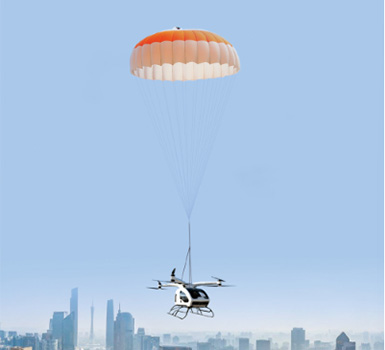
Parachute recovery systems for fixed-wing UAVs provide essential safety benefits:
Controlled descent and stabilization
Protection of structural and payload integrity
Independent operation in case of system failure
Compliance with safety management and regulatory standards
For professional fixed-wing UAV operations, a well-engineered parachute system is not optional—it is a critical component for ensuring predictable and safe recovery under emergency conditions.


