
Parachute Certification Standards Explained (FAA, EASA, CAAC)

Parachute systems used in aviation, UAV recovery, training, rescue, and experimental applications are subject to different certification and regulatory frameworks depending on where they are designed, manufactured, and operated. Among the most frequently referenced authorities are the FAA (United States), EASA (European Union), and CAAC (China).
Understanding how these certification systems work, what they cover, and where their boundaries lie is essential for manufacturers, buyers, and operators evaluating parachute safety, compliance, and operational acceptance. This article provides a technical, non-promotional explanation of parachute certification standards under FAA, EASA, and CAAC oversight, with a focus on how these frameworks apply in real-world scenarios.
Why Parachute Certification Standards Matter
Parachute certification standards exist to ensure that systems:
Perform predictably within defined operating limits
Meet minimum structural and material safety requirements
Are manufactured under controlled quality systems
Can be inspected, maintained, and operated safely over time
Certification does not guarantee universal suitability. Instead, it establishes a verified baseline for specific applications, conditions, and user categories.
For international projects and cross-border operations, understanding certification differences is critical to avoiding incorrect assumptions about equivalency.
What Does “Certification” Mean for Parachutes?
Unlike aircraft, parachutes are not always certified as standalone products in every jurisdiction. Certification may apply to:
The parachute design
The manufacturing process
The intended application (sport, emergency, UAV recovery, rescue)
The operator or rigger
In some cases, parachutes are approved indirectly as part of a larger system rather than through a single universal certificate.
FAA Parachute Certification and Regulatory Framework
FAA Oversight Scope
In the United States, parachute regulation primarily falls under the Federal Aviation Administration (FAA), with emphasis on civil aviation and sport parachuting.
Key regulatory references include:
Title 14 of the Code of Federal Regulations (14 CFR)
Advisory Circulars related to parachute operations
FAA oversight focuses more on airworthiness, packing, and operational use than on certifying every parachute design type.
TSO-C23 Series: Technical Standard Orders
The most widely recognized FAA parachute standard is TSO-C23, which defines minimum performance requirements for personnel parachutes.
Key elements include:
Structural strength requirements
Opening shock limits
Descent rate performance
Environmental conditioning tests
TSO-C23 has evolved through multiple revisions (C23b, C23c, C23d), each reflecting changes in materials, testing methods, and operational understanding.
What FAA TSO Certification Covers
TSO authorization indicates that:
The parachute design meets defined minimum standards
The manufacturer has an approved quality system
Production conforms to the approved design
However, TSO approval does not certify suitability for:
UAV recovery systems
Cargo airdrop systems
Experimental or non-personnel applications
These systems often fall outside FAA personnel parachute definitions.
EASA Parachute Certification Approach
EASA Regulatory Philosophy
The European Union Aviation Safety Agency (EASA) governs civil aviation safety across EU member states. EASA’s approach emphasizes harmonized standards and continued airworthiness.
Parachutes may be regulated under:
CS (Certification Specifications)
ETSO (European Technical Standard Orders)
ETSO-C23 and Harmonization with FAA
EASA’s ETSO-C23 closely aligns with FAA TSO-C23 requirements, enabling mutual recognition in many personnel parachute contexts.
Key similarities:
Comparable strength and performance testing
Similar descent rate and opening criteria
Equivalent environmental conditioning
Differences typically relate to:
Documentation format
Compliance demonstration procedures
Continued airworthiness oversight
For personnel parachutes, FAA TSO and EASA ETSO approvals are often treated as functionally equivalent within defined limits.
EASA Scope Limitations
Like the FAA, EASA standards focus primarily on:
Sport parachuting
Emergency personnel descent systems
Specialized systems such as UAV recovery parachutes are usually addressed through project-specific approvals or national aviation authority coordination, rather than ETSO certification.
CAAC Parachute Certification and Approval Framework
Role of the CAAC
The Civil Aviation Administration of China (CAAC) oversees aviation safety and certification within China. CAAC regulation combines elements of international standards with domestic approval mechanisms.
CAAC certification applies to:
Aviation products manufactured in China
Imported aviation equipment for domestic use
Special aviation and sports equipment under designated programs
Product Qualification vs Certification
Unlike FAA and EASA systems, CAAC approvals for parachutes may take the form of:
Model qualification certificates
Production licenses
Designated testing or evaluation approvals
These approvals are often application-specific and linked to defined operational use cases rather than broad product categories.
Sports Aviation and Special Equipment Oversight
In sports aviation and specialized parachute applications, CAAC may authorize:
Specific manufacturers
Designated test centers
Approved product models
For example, Nanjing Hongguang General Aviation Equipment Technology Co., Ltd. has participated in CAAC-related qualification and testing frameworks for aviation sports and parachute systems, reflecting how Chinese regulatory pathways often emphasize controlled application environments and institutional oversight.

Certification vs Application: A Critical Distinction
One of the most common misunderstandings is assuming that a certified parachute can be used universally.
In reality:
Certification applies only within defined parameters
Deployment speed, altitude, and payload limits are critical
Certification does not replace system-level engineering analysis
A parachute certified for personnel use may be unsuitable for UAV recovery, even if load capacity appears sufficient.
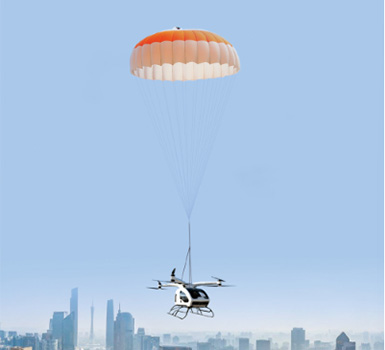
UAV Recovery and Non-Personnel Parachutes
Why Standard Certifications Often Do Not Apply
UAV recovery parachutes typically operate:
At higher deployment speeds
With different mass distributions
Without human descent criteria
As a result, they are rarely covered by FAA TSO-C23 or EASA ETSO standards.
Instead, validation relies on:
Internal qualification testing
Project-specific acceptance criteria
Customer or authority witnessing
This does not imply lower safety, but rather different evaluation frameworks.
International Acceptance and Mutual Recognition
When Certifications Are Recognized Across Borders
FAA and EASA certifications often benefit from bilateral agreements, enabling limited mutual acceptance for personnel parachutes.
CAAC acceptance of foreign certifications may require:
Additional documentation
Supplemental testing
Local operational approval
International projects must account for these regulatory interfaces early in system selection.
Common Certification Misconceptions
Several recurring misconceptions appear in procurement and project planning:
“FAA-certified means globally approved”
“Certification replaces operational testing”
“Higher certification always means higher performance”
“Uncertified means unsafe”
In practice, certification is a baseline compliance mechanism, not a universal performance guarantee.
Practical Guidance for Buyers and Operators
When evaluating parachute certification claims, consider the following:
Identify the exact standard and revision
Confirm the intended application scope
Verify deployment conditions covered by approval
Assess compatibility with local regulatory requirements
Evaluate manufacturer testing and operational history
This approach prevents misalignment between certification status and actual mission needs.
Certification in the Context of System Engineering
Parachutes rarely operate in isolation. Their certification status must align with:
Deployment mechanisms
Structural interfaces
Control electronics
Recovery procedures


System-level validation often matters more than individual component certification, especially in UAV and experimental missions.
FAA, EASA, and CAAC parachute certification frameworks share a common goal: establishing minimum safety and performance standards within defined application boundaries. However, they differ in scope, structure, and applicability, particularly outside personnel parachuting.
Understanding what each certification standard covers—and what it does not—is essential for correct system selection and regulatory compliance. Rather than viewing certification as a universal approval, it should be treated as one element within a broader engineering, operational, and regulatory evaluation process. For global and special-mission applications, informed interpretation of certification standards is a key factor in achieving safe, compliant, and effective parachute system integration.


