
Emergency Parachute System for Long-Endurance Drones
Long-endurance drones are designed to remain airborne for extended periods, often operating far beyond visual line of sight and in complex environments. While endurance capability increases mission efficiency, it also introduces higher cumulative risk over time. Mechanical fatigue, power system degradation, environmental exposure, and system-level faults become statistically more likely as flight duration increases.
For this reason, emergency parachute systems have become a critical safety component for long-endurance UAV platforms. This technical guide explains how emergency parachute systems function, why they are particularly important for endurance drones, and how they should be integrated into mission-critical aircraft designs.
Characteristics of Long-Endurance Drones
Long-endurance UAVs typically share several operational characteristics:
Extended continuous flight time
High battery or fuel energy capacity
Fixed-wing or hybrid VTOL configurations
Long communication distances
Reduced pilot intervention frequency
These characteristics fundamentally change the safety profile compared to short-duration multirotor drones.
Why Endurance Increases Safety Risk
Accumulated System Stress
Components such as motors, bearings, connectors, and power electronics experience thermal and mechanical stress over prolonged operation.
Power Depletion Uncertainty
As energy reserves decrease, voltage instability and sudden power drops become more likely.
Environmental Exposure
Long flights expose UAVs to:
Temperature variation
Turbulence layers
Humidity and precipitation
Wind shear
Reduced Recovery Options
Long-endurance missions often occur far from takeoff locations, limiting emergency landing choices.
Role of Emergency Parachute Systems
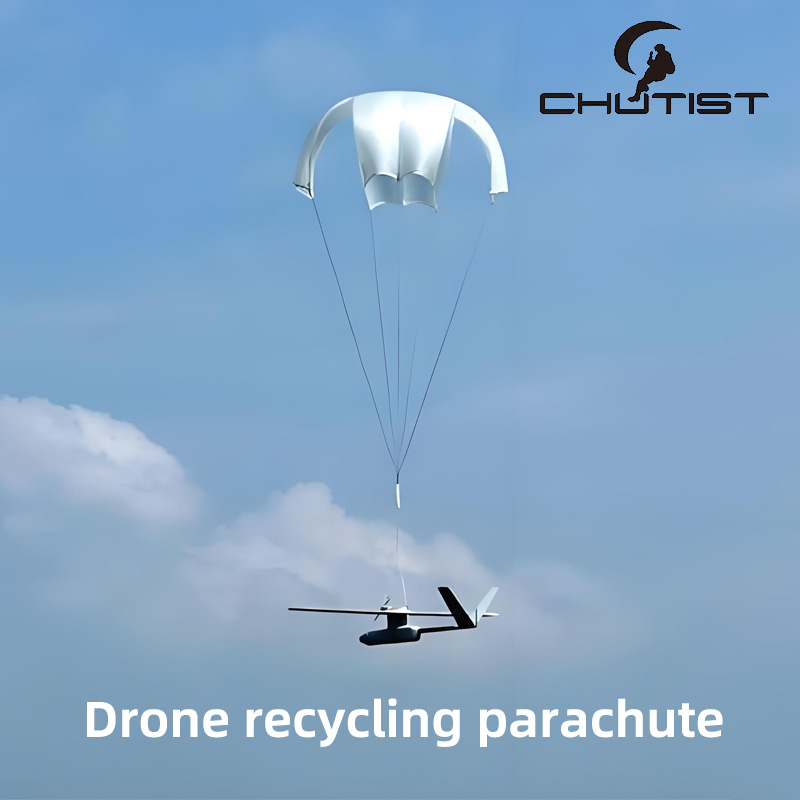
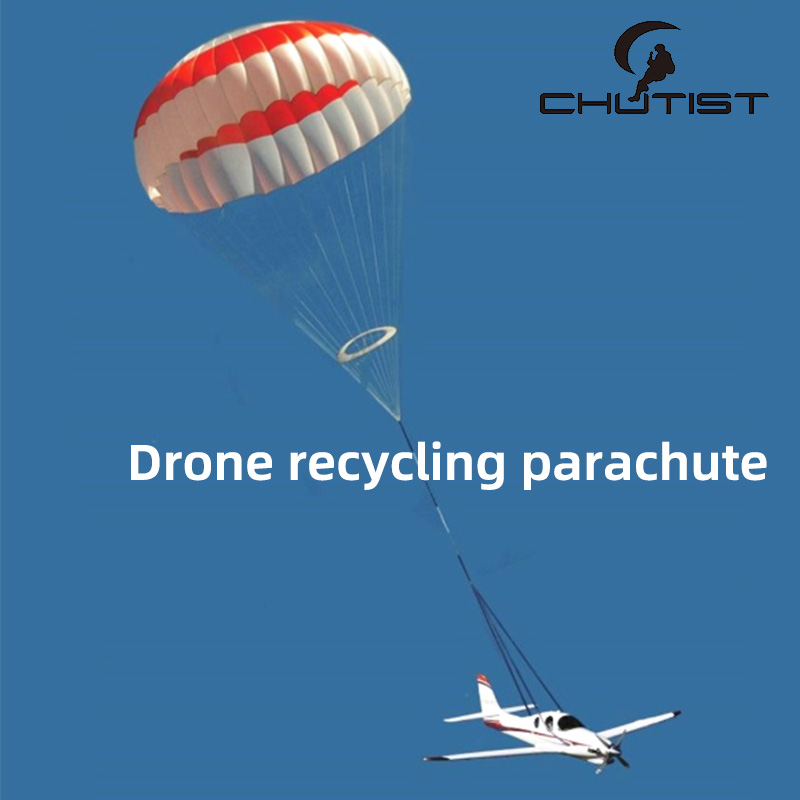
An emergency parachute system provides a passive recovery mechanism when continued controlled flight is no longer possible.
Its core function is not to save the mission, but to prevent catastrophic consequences when mission continuation fails.
Once activated, the system converts an uncontrolled descent into a predictable and energy-managed landing.
Key Safety Objectives for Endurance UAVs
Emergency parachute systems for long-endurance drones aim to:
Reduce ground impact energy
Stabilize aircraft orientation during descent
Protect critical payload systems
Prevent secondary damage from high-speed crashes
Support regulatory safety frameworks
Typical Emergency Activation Scenarios
Parachute deployment may occur during:
Complete propulsion failure
Critical battery voltage collapse
Structural damage during cruise
Flight controller malfunction
Communication loss with abnormal attitude
Severe weather-induced instability
Because endurance drones operate over long distances, autonomous detection logic is essential.
Autonomous Trigger Architecture
Emergency parachute systems commonly use independent trigger mechanisms, including:
Dedicated inertial sensors
Accelerometers detecting abnormal descent
Attitude deviation thresholds
Power loss detection circuits
Independence from the primary flight controller significantly increases reliability.
Deployment Requirements for Endurance Platforms
Minimum Deployment Altitude
Endurance UAVs typically operate at higher cruise altitudes, providing sufficient vertical space for parachute inflation.
However, descent rate, aircraft mass, and canopy size must be matched carefully.
Deployment Speed Range
High cruise speeds require:
Rapid extraction systems
Strong deployment containers
Reinforced lines and canopy fabric
Incorrect deployment design can cause partial inflation or structural failure.
Structural Integration Considerations
Parachute systems must be structurally integrated to:
Transfer opening loads safely
Avoid canopy entanglement
Maintain center-of-gravity alignment
Prevent interference with propellers or control surfaces
Mounting design plays a critical role in recovery effectiveness.
Weight vs Endurance Trade-Off
One of the most important design questions is whether adding a parachute reduces endurance.
In practice:
Parachute mass typically represents a small percentage of total UAV weight
Improved safety often enables regulatory approval for longer missions
Reduced crash loss outweighs minor endurance reduction
For endurance drones, safety margin often has higher operational value than maximum flight time.
Parachute System Testing Requirements
Reliable emergency systems must undergo extensive testing:
Static load testing
Deployment timing validation
High-speed extraction testing
Repeated repack cycles
Environmental aging tests
Testing ensures consistent performance throughout the drone’s service life.
Application Scenarios
Emergency parachute systems are widely used in:
Long-range mapping UAVs
Environmental monitoring platforms
Border patrol drones
Maritime surveillance aircraft
Communication relay UAVs
Scientific research missions
In these scenarios, recovery reliability is essential.
Operational Benefits Beyond Safety
Beyond immediate crash protection, parachute systems also provide:
Lower insurance risk profiles
Reduced asset loss rates
Improved operator confidence
Better compliance with safety management systems
These indirect benefits often justify integration costs.
Manufacturer Engineering Support
For endurance UAV platforms, selecting a parachute supplier with aerospace-level design experience is critical.
Manufacturers such as Nanjing Hongguang General Aviation Equipment Technology Co., Ltd. provide emergency parachute systems engineered with controlled deployment behavior, verified load capacity, and repeatable reliability suitable for long-duration UAV operations.
Emergency parachute systems play a vital role in protecting long-endurance drones by:
Managing cumulative operational risk
Providing independent failure recovery
Reducing crash energy and unpredictability
Supporting safe BVLOS and extended missions
As UAV endurance continues to increase, passive recovery systems are becoming an essential component of responsible and professional drone design.
For long-endurance UAV platforms, an emergency parachute system is not simply an accessory—it is a fundamental safety safeguard.


