
Drop Test Requirements for Aviation Parachutes

Drop testing is one of the most critical validation steps for aviation parachutes. Unlike static inspections or material testing, a drop test evaluates how a parachute system behaves during actual deployment and descent, where aerodynamic forces, opening shock, and load distribution occur simultaneously. For personnel parachutes, UAV recovery systems, and specialized aviation applications, drop tests provide essential evidence of real-world performance.
This article explains the drop test requirements for aviation parachutes, including test objectives, test configurations, measured parameters, regulatory expectations, and common challenges. The focus is on technical understanding rather than certification claims or product promotion.
What Is a Drop Test in Aviation Parachute Testing?
A drop test is a controlled release of a parachute-equipped payload from a defined height and speed to evaluate system behavior during deployment and descent.
Unlike static or ground-based tests, drop tests assess:
Deployment sequence reliability
Inflation behavior
Opening shock loads
Descent stability
Structural integrity under dynamic conditions
Drop testing is often considered the closest simulation of operational use available during development and qualification.
Why Drop Testing Is Essential for Aviation Parachutes
Parachutes experience their highest stresses during deployment. Computational analysis and bench testing cannot fully replicate the complex interactions between airflow, fabric inflation, and moving payloads.
Drop testing is required to:
Validate design assumptions
Confirm compatibility between parachute and payload
Identify unstable or asymmetric inflation
Measure peak loads during opening
Demonstrate repeatability across multiple deployments
Without drop testing, critical failure modes may remain undetected until operational use.
Typical Applications Requiring Drop Tests
Drop test requirements vary depending on application, but they are commonly required for:
Personnel emergency parachutes
Aviation sports parachutes
UAV recovery parachute systems
Experimental aircraft recovery devices
Cargo or equipment descent systems
Each application category defines its own test objectives and acceptance criteria.
Core Objectives of Parachute Drop Tests
Although test details differ, most drop tests aim to evaluate several core performance aspects.
Deployment Reliability
The parachute must deploy fully and correctly without:
Line entanglement
Incomplete inflation
Premature structural damage
Reliable deployment is often evaluated across multiple test drops.
Opening Shock and Load Measurement
Opening shock generates the highest loads experienced by the system.
Drop tests measure:
Peak line loads
Load rise rate
Load duration
These values must remain within defined design limits and safety margins.
Descent Rate and Stability
After inflation, the parachute must provide a predictable descent.
Evaluations include:
Average descent speed
Oscillation or pendulum motion
Heading or directional stability
Unstable descent can indicate design or integration issues even if structural limits are not exceeded.
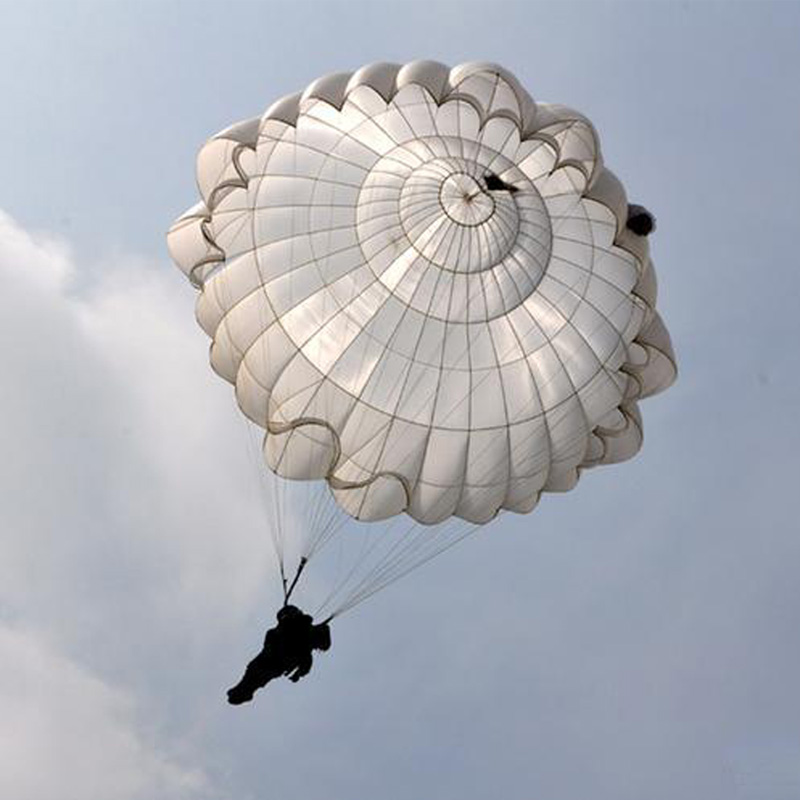
Drop Test Platforms and Methods
Tower and Crane Drop Tests
Tower or crane drops involve releasing the payload vertically from a fixed structure.
Advantages:
Controlled environment
Repeatable conditions
Suitable for low-speed deployment
Limitations:
Cannot simulate forward airspeed
Limited altitude
These tests are often used in early development stages.
Aircraft-Based Drop Tests
Aircraft drop tests release the payload from a fixed-wing aircraft or helicopter.
Advantages:
Realistic airflow conditions
Adjustable deployment speeds
Higher altitudes
Limitations:
Higher cost
More complex logistics
Greater safety considerations
Aircraft drops are commonly required for final validation.
UAV-Based Drop Tests
For UAV recovery parachutes, drops may be performed from unmanned platforms.
This approach allows:
Direct evaluation of system integration
Testing under realistic UAV dynamics
Repeated trials with minimal crew risk
Key Parameters Defined in Drop Test Requirements
Drop Height and Altitude
Test altitude affects:
Air density
Inflation time
Descent rate
Drop tests must reflect the minimum and maximum operational altitudes expected in service.
Deployment Speed
Deployment speed has a major influence on opening shock.
Test requirements often specify:
Minimum deployment speed
Maximum deployment speed
Intermediate conditions
Testing across this range ensures robustness under varying scenarios.
Payload Mass and Configuration
The payload used in testing must represent:
Maximum rated load
Minimum expected load (if applicable)
Actual mass distribution and center of gravity
Incorrect payload configuration can invalidate test results.
Deployment Orientation
Orientation at deployment affects inflation behavior.
Drop tests may include:
Stable orientation releases
Slightly misaligned or tumbling releases
Worst-case attitude scenarios
This helps assess tolerance to non-ideal conditions.
Instrumentation and Data Collection
Accurate data collection is essential for meaningful drop test results.
Commonly Measured Data
Line and attachment loads
Acceleration during opening
Time to full inflation
Descent velocity
High-speed sensors are required to capture peak values accurately.
Visual Documentation
Video recording is often used to analyze:
Inflation sequence
Canopy symmetry
Oscillation behavior
Visual data complements numerical measurements and helps identify qualitative issues.
Acceptance Criteria in Drop Testing
Drop test acceptance criteria depend on application and regulatory context but typically include:
No structural failure or tearing
Loads within defined limits
Stable, controlled descent
Repeatable results across multiple drops
Passing a single drop test is rarely sufficient; consistency is a key requirement.
Regulatory and Standardization Considerations
Personnel Parachutes
For personnel parachutes, drop test requirements are often linked to recognized standards such as FAA TSO or EASA ETSO specifications, which define:
Number of required drops
Load conditions
Environmental conditioning
These tests support certification and operational approval.
UAV and Special-Mission Parachutes
For UAV recovery and special-mission systems, drop test requirements are typically project-specific.
Authorities or customers may define:
Test envelopes
Documentation expectations
Witnessing or reporting procedures
In these cases, drop testing serves as an engineering validation tool rather than formal certification.
Environmental Conditioning Before Drop Tests
To ensure realism, drop tests are often conducted after environmental exposure.
Common Conditioning Factors
UV exposure
Temperature extremes
Humidity or moisture
Storage aging
Conditioning helps reveal performance changes that may not appear in new materials.
Common Challenges in Drop Testing
Despite careful planning, drop testing presents practical difficulties.
Variability in Atmospheric Conditions
Wind, turbulence, and temperature variations can affect results.
Mitigation strategies include:
Multiple test repetitions
Statistical analysis
Conservative acceptance margins
Scaling Issues
Small-scale drop tests may not accurately represent full-size systems.
Scaling laws do not always translate directly, particularly for:
Fabric inflation dynamics
Line behavior
Full-scale testing is often necessary for final validation.
Integration-Related Failures
Many drop test failures are caused not by the parachute itself, but by:
Improper mounting
Deployment mechanism interference
Sensor or wiring issues
System-level preparation is critical.
The Role of Manufacturer Experience
Effective drop testing requires more than equipment and procedures. It depends heavily on understanding how parachutes behave across different platforms and mission profiles.
Manufacturers with extensive experience in aviation parachutes and UAV recovery systems are better positioned to define realistic test conditions and interpret results correctly. For instance, Nanjing Hongguang General Aviation Equipment Technology Co., Ltd. has conducted drop testing across a wide range of payload classes and deployment environments, allowing test requirements to be aligned with real operational stresses rather than idealized assumptions.
Using Drop Test Results in System Design
Drop test outcomes are rarely the final step. Results are typically used to:
Refine canopy geometry
Adjust line lengths or materials
Modify deployment sequencing
Define operational limitations
Iterative testing is common, particularly for new or customized designs.

Drop test requirements for aviation parachutes are designed to verify real-world performance under dynamic, high-stress conditions that cannot be fully replicated through analysis or static testing alone. By evaluating deployment reliability, opening shock, descent stability, and structural integrity, drop tests provide critical evidence of system safety and suitability.
Whether applied to personnel parachutes, UAV recovery systems, or specialized aviation missions, well-defined and properly executed drop tests form the foundation of responsible parachute system validation. Understanding these requirements allows engineers, operators, and buyers to better assess system credibility and long-term operational reliability.


