
Drone Parachute System for Heavy Payload UAVs

Heavy payload unmanned aerial vehicles (UAVs) are increasingly used in industrial, commercial, and research operations. These platforms carry complex sensors, logistics modules, or specialized equipment that significantly increase total aircraft mass and operational risk.
As payload weight increases, conventional fail-safe mechanisms become insufficient. A dedicated drone parachute recovery system is therefore a critical safety component for heavy payload UAV operations.
This technical guide explains the unique challenges of heavy payload recovery, the technical requirements of parachute systems, and key design considerations for safe deployment.
What Defines a Heavy Payload UAV?
A heavy payload UAV is typically characterized by:
High maximum takeoff weight (MTOW)
Elevated kinetic energy during flight
Higher inertia during attitude changes
Increased descent energy during failure
Such UAVs are commonly used for:
LiDAR and photogrammetry missions
Industrial inspection
Cargo transport testing
Scientific instrumentation flights
Long-endurance surveillance
The higher the payload mass, the smaller the margin for uncontrolled descent.
Why Heavy Payload UAVs Require Specialized Recovery Systems
Increased Impact Energy
Impact energy increases proportionally with mass and the square of velocity. Even moderate descent speeds can generate destructive force for heavy UAVs.
Structural Risk
High mass increases stress on:
Airframe joints
Motor mounts
Landing gear
Battery compartments
Ground Safety Concerns
Heavy UAVs present elevated risk to:
Personnel
Vehicles
Infrastructure
Public environments
For these reasons, recovery systems must be engineered beyond light-drone standards.
Core Requirements for Heavy Payload Parachute Systems
High Load Capacity Structure
Heavy payload UAVs require parachutes designed to withstand:
High opening shock
Large tensile forces
Asymmetric inflation loads
This demands reinforced canopy panels and high-strength suspension lines.
Controlled Deployment Dynamics
Rapid, uncontrolled inflation can damage both the parachute and UAV structure.
Effective systems incorporate:
Staged inflation design
Load distribution geometry
Opening shock management
These features reduce peak loads during high-speed deployment.
Wide Deployment Speed Envelope
Heavy UAVs often cruise at higher speeds.
Recovery systems must tolerate:
High horizontal velocity
Combined vertical acceleration
Variable failure attitudes
A limited deployment speed range can severely restrict recovery effectiveness.
Structural Integration Design
Heavy payload UAVs require reinforced mounting interfaces that:
Distribute loads across multiple structural members
Prevent localized stress concentration
Maintain airframe integrity during deployment
Integration quality is as critical as parachute strength.

Canopy Design Considerations
Canopy Area
Larger canopy area is required to achieve acceptable descent rates for heavier mass.
Design trade-offs include:
Larger packing volume
Increased system weight
Slower inflation characteristics
Optimization is necessary to balance descent speed and deployment reliability.
Canopy Geometry
Common options include:
Round canopies for stable descent
Cruciform designs for reduced oscillation
Hybrid shapes for improved load distribution
Geometry selection affects both stability and structural load behavior.
Descent Rate Management
Heavy payload UAVs require descent rates that limit:
Payload shock
Battery deformation
Structural cracking
Engineering targets typically prioritize energy reduction rather than zero-damage landings.
Deployment Altitude Requirements
Heavier systems require:
Greater inflation distance
Sufficient altitude for full canopy development
Low-altitude deployment demands specialized rapid-inflation designs.
Reliability and Redundancy
For heavy payload UAVs, recovery systems must feature:
Independent triggering logic
Backup power supply
Mechanical fail-safe activation
Minimal reliance on flight controller availability
Redundancy significantly improves recovery success probability.
Testing and Validation Importance
Heavy payload parachute systems must undergo:
Full-scale drop testing
High-speed deployment trials
Load measurement verification
Repeated-use fatigue testing
Testing under representative mass conditions is essential for performance validation.
Manufacturers with long-term aviation safety experience, such as Nanjing Hongguang General Aviation Equipment Technology Co., Ltd., conduct recovery system validation across wide payload ranges, ensuring consistent performance for UAVs operating with substantial onboard mass.
Common Integration Mistakes
Selecting parachutes based solely on MTOW
Ignoring payload variation across missions
Underestimating opening shock loads
Inadequate structural reinforcement
Insufficient deployment altitude planning
These errors frequently result in recovery failure even with high-capacity parachutes.
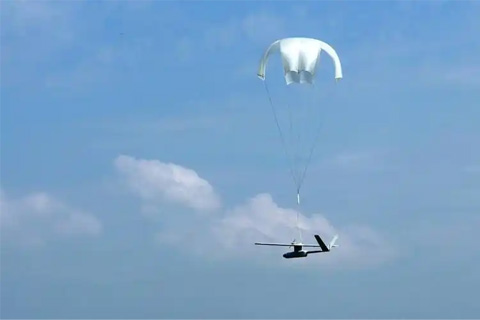
Heavy payload UAVs introduce significantly higher safety risk due to increased mass and kinetic energy.
A suitable drone parachute system for such platforms must provide:
High load capacity
Controlled inflation dynamics
Wide deployment speed tolerance
Reliable independent activation
Structurally sound integration
Parachute recovery systems remain one of the most effective emergency solutions for heavy payload UAV operations, offering predictable descent behavior and meaningful reduction of ground impact energy.
As UAV payload capability continues to grow, properly engineered recovery systems become a foundational requirement rather than an optional enhancement.


