
Drone Crash Protection Solutions Explained

As drone operations expand across industrial, commercial, and research sectors, protecting UAVs, payloads, and surrounding environments from crash-related damage has become a critical concern. Crash protection solutions encompass multiple technologies designed to mitigate impact energy, stabilize the aircraft, and preserve valuable equipment.
This technical guide explains the primary crash protection approaches for drones, comparing their mechanisms, operational benefits, and integration considerations.
Understanding Drone Crash Risks
Drone crashes can occur due to:
Propulsion or battery failure
Flight controller malfunction
Loss of GPS or sensor input
Adverse weather conditions
Pilot error or communication loss
Consequences include:
Structural damage to the UAV
Destruction of sensors, cameras, or payloads
Risk of injury to personnel or bystanders
Damage to property or infrastructure
Effective crash protection systems reduce these risks and support safer operations.
Main Crash Protection Solutions
1. Drone Parachute Recovery Systems
How They Work
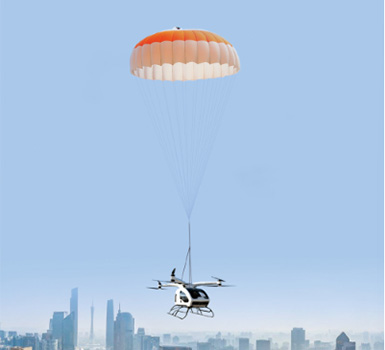
Parachute recovery systems deploy a canopy to slow descent and stabilize UAV orientation. They operate independently from primary propulsion and flight control systems.
Benefits
Reduces descent speed and impact energy
Stabilizes flight attitude during failure
Protects high-value payloads
Suitable for high-altitude and high-speed UAVs
Limitations
Requires minimum deployment altitude
Slightly increases UAV mass
Deployment timing is critical


2. Airbag Recovery Systems
How They Work
Airbags rapidly inflate upon detecting imminent ground contact to absorb impact energy and cushion the UAV.
Benefits
Protects UAV structure at low altitude
Compact and lightweight
Provides immediate impact energy absorption
Limitations
Less effective for high-speed or high-altitude crashes
Requires precise sensor detection
Minimal stabilization during descent
3. Energy-Absorbing Landing Gear
How It Works
Landing gear with integrated shock absorbers or deformable materials reduces impact forces during hard landings or minor crashes.
Benefits
Reduces damage to airframe and payload
Lightweight and reusable
Simple mechanical integration
Limitations
Ineffective in high-altitude uncontrolled falls
Limited protection for horizontal motion
4. Hybrid Solutions
Some UAVs integrate multiple protective technologies:
Parachute for high-altitude descent
Airbag for final ground cushioning
Shock-absorbing landing gear for minor impacts
Hybrid systems maximize safety across a variety of failure scenarios.
Key Considerations for Implementation
UAV Mass and Payload
Higher payloads require stronger parachutes or reinforced airbags.
Flight Altitude and Speed
Deployment mechanisms must match operational conditions.
Structural Integration
Mounting points must distribute loads evenly.
Avoid interference with propellers, sensors, or payloads.
Trigger Reliability
Systems should operate independently from flight controllers.
Redundant activation logic enhances reliability.
Testing and Validation
Full-scale drop tests
Deployment under representative speeds and altitudes
Repeated-use durability verification
Manufacturers with aviation-grade experience, such as Nanjing Hongguang General Aviation Equipment Technology Co., Ltd., offer crash protection systems validated for a range of UAV sizes and mission profiles.
Applications
Crash protection solutions are critical in:
Industrial inspection UAVs
Surveying and mapping drones
Long-endurance research platforms
Cargo or logistics UAVs
Urban air mobility drones
High-value payload operations
These systems reduce risk to both UAV operators and surrounding environments.
Drone crash protection solutions improve operational safety by:
Reducing descent speed and impact energy
Stabilizing UAV flight attitude during emergencies
Protecting payloads and structural components
Enhancing reliability for industrial and research missions
For professional UAV operations, integrating appropriately engineered crash protection solutions is essential for mitigating risk and maintaining operational continuity. Selecting systems with validated performance across multiple failure scenarios ensures predictable outcomes and improved safety assurance.


