
Best Travel Duffel Backpack: A Two-Mode Selection Guide
The best travel duffel backpack is a genuine two-mode tool. It should open and pack like a duffel when the user needs broad access, then convert into a stable hands-free carry when walking through a station, airport, hotel or campsite. A product that merely adds two straps to a soft cylinder may look convertible without performing either mode well.
Begin with the journey sequence. List how the bag will be moved from home to vehicle, check-in counter, accommodation and final activity. Mark the points where the bag is carried by hand, worn on the back, placed on a rack or secured as cargo. This separates a real hybrid requirement from a preference for the word duffel.
Define what the best travel duffel backpack must convert between
A travel duffel backpack should not be judged in one preferred mode. Load it first as a duffel and confirm that the opening exposes the main contents without forcing the sides to collapse. Then deploy the backpack straps, close or secure the carry handles and walk with the same load. The conversion should not leave loose straps, hard buckles against the body or handles that swing into the legs.
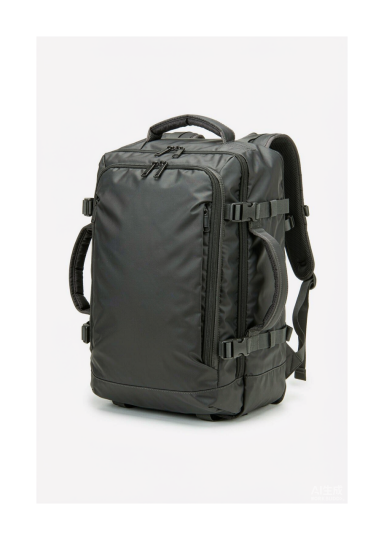
Use the CHUTIST backpack and waterproof-bag range to distinguish product roles before comparing details. The category includes backpacks and motorcycle/travel bags, but the presence of both categories does not prove that every duffel has a backpack harness or that every backpack is suitable for cargo mounting.
Build the load around packing geometry
Duffels favor a wide opening and flexible interior. Backpacks favor a shape that stays close to the body. A hybrid has to manage both. Place dense items along the panel that becomes the back in backpack mode. Keep soft clothing around rigid edges and leave the closing path free. If the load rolls away from the body when worn, the bag may have the wrong depth or insufficient internal control for that job.
Do not select capacity from trip length alone. Create the final packing list, add only justified contingency items and measure the packed external shape. Flexible bags can bulge beyond their nominal dimensions, especially when the opening is filled to its limit. The airline or transport operator controls the allowed dimensions and item count, so verify the itinerary rules rather than assuming a stated capacity is a carry-on guarantee.
Transition | Acceptance check |
Home to vehicle | Handles balance the packed bag without twisting |
Station or airport walk | Backpack straps deploy quickly and unused handles are secured |
Storage rack or cargo area | Packed dimensions and closure remain within the operator's rules |
Arrival and unpacking | Main opening exposes contents without emptying the whole bag |
Test the carry system at the final weight
Deploy the straps only after the bag is fully packed. Adjust them, walk for ten minutes, turn, climb stairs and lift the bag from the floor. Check whether the load sits symmetrically and whether any hardware presses into the back. A sternum strap, load lifter or padded panel should be evaluated only when the exact candidate includes it; those features cannot be assumed from the product type.
The hand-carry mode also needs a test. Lift from each handle, place the bag on a counter and move it into a rack. If the handles are positioned only for an empty showroom bag, the packed load may tilt or concentrate force at one seam. Reject the candidate if either carry mode feels like an afterthought.
Inspect the conversion hardware as one system
Examine every component used during conversion: strap anchors, adjustment sliders, buckles, handle wraps and the pockets that store unused straps. Pull each component in the direction created by the packed load. Confirm that a stored strap cannot work loose and that a deployed strap does not cross the main opening or a high-frequency pocket.
Repeat the conversion while wearing gloves or a jacket if those conditions are part of the trip. The mechanism should remain understandable without a flat surface or a long setup. A design that needs several loose clips may be acceptable for occasional conversion but inefficient when the user changes modes at every transfer. Record that tradeoff instead of treating more hardware as automatically better.
Set a precise weather and closure boundary
Material names are useful starting points, not complete weather results. Inspect the closure, seams, valves and any openings created by straps or pockets. Ask whether the product is intended for rain, splash, short exposure or another defined condition. Do not convert the word waterproof into an immersion duration or IP rating unless a suitable test result is supplied.
For example, the CHUTIST 66L PVC motorcycle and travel duffel page lists 66L capacity, PVC material, an air-release valve and reflective elements for models in that product scope. Those facts help illustrate a large travel or motorcycle duffel, but the page does not make it an airline cabin bag and should not be used to infer a convertible backpack harness.
Verify transport fit before departure
Measure the packed bag at its widest points, including handles and pockets that cannot be compressed. Weigh it with the exact travel contents. The European Union's official luggage guidance states that airlines set cabin-baggage size and item limits, so the correct check is the operating carrier for every flight segment. Security and dangerous-goods rules are a separate question from bag dimensions.
Run one final conversion under time pressure: close the duffel, secure loose components, deploy the backpack straps, walk, return to hand carry and place the bag in its intended storage position. If the process causes tangles, exposes openings or requires unpacking, revise the configuration before travel.
Also test the smallest storage space expected on the route. A flexible duffel may compress when lightly packed but become rigid at full capacity. Place the final load in a measured shelf, rack or vehicle compartment and confirm that removal does not pull on a strap or zipper. This check keeps storage fit separate from the question of whether the bag can be carried comfortably.
Conclusion
The best travel duffel backpack proves both modes with the same final load. It offers useful duffel access, controlled backpack carry, a defensible weather boundary and packed dimensions that match the real transport plan. For product or OEM discussions, share the intended load, route and carry transitions with CHUTIST rather than requesting a generic best model.
Sources
Source: Your Europe: Luggage restrictions


