Are Hot Air Balloons Safe? How To Ensure Safety?
Are hot air balloons safe?
I can tell you with absolute certainty that hot air balloons are safe. Historical accident data in the United States shows an accident rate of less than 0.01%. Statistics show that the number of deaths worldwide caused by hot air balloons is typically less than 30 per year. Furthermore, in popular regions and festivals such as the Albuquerque International Balloon Fiesta, Bristol International Balloon Fiesta, Saga International Balloon Fiesta, and Cappadocia Hot Air Balloon Festival, accidents are extremely rare out of hundreds of thousands of flights. From a probabilistic perspective, it is safe.

Safety Standards System
The main international hot air balloon safety standards system includes the following:
International Civil Aviation Organization (ICAO)
Develops globally unified aviation safety and operational standards.
Federal Aviation Administration (FAA)
Responsible for the oversight and enforcement of U.S. civil aviation safety regulations.
European Union Aviation Safety Agency (EASA)
Unifies European Union aviation safety standards and certification systems.
Civil Aviation Administration of China (CACC)
Oversees China's civil aviation safety, airworthiness, and flight approval system.
Common hot air balloon accidents
Hard Landing Accidents
These accidents mainly occur due to excessive speed during descent or sudden changes in wind speed, causing the basket to tip over, be dragged, or overturn. These accidents can result in minor abrasions or sprains for passengers.
Strong Wind Dragging
If the balloon is not deflated promptly after landing, it may be blown away from your position by strong winds. In severe cases, the basket may slide or even roll over on the ground.

Fire Accidents
The most common cause of hot air balloon fires is a problem with the burner or fuel (propane). Once the balloon catches fire, it will cause an emergency descent at high altitude.
Collision with Obstacles
Accidents can occur if you collide with various objects during flight, such as power lines, trees, and buildings. This is mainly due to low-altitude flight and strong winds making wind direction control difficult.
The probability of these four common accidents is relatively low. In fact, CHUTIST have never had a single accident with any of our hot air balloon products. We have never filed a claim with any insurance company because our hot air balloons are extremely safe. Contact us for a quote
What are the key factors affecting the safety of hot air balloons?
Hot air balloon safety mainly includes weather conditions, pilot experience and judgment, landing environment, equipment and maintenance status, and passenger cooperation.
Safety precautions for flying
Pre-flight preparations
• Choose a reputable operating company to ensure it has legal qualifications, professional pilots, and a robust safety system.
• Choose during good weather conditions, avoiding strong winds, rain, or unstable air currents.
• Attend safety briefings to understand and strictly adhere to the precautions for takeoff, flight, and landing.
• Wear appropriate clothing such as long pants and athletic shoes; avoid flip-flops or high heels.
• Always check your belongings to ensure your phone and camera are securely fastened to prevent them from falling during the flight.
Precautions in the air
• Please keep your body stable and avoid jumping or swaying to prevent affecting the basket's balance.
• Leaning out of the basket may result in accidental collision or falling.
• All operations during the flight are subject to the pilot's instructions.
• Passengers should hold their mobile phones and cameras securely or fasten them to prevent them from falling at high altitudes.
• Passengers should stay away from the burner area and avoid touching or standing directly below it.
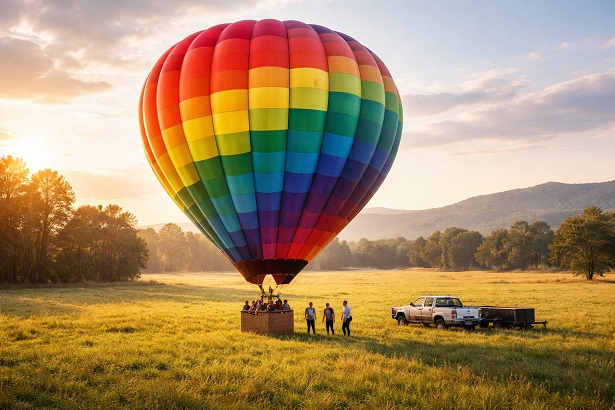
Precautions before landing
• Follow the pilot's instructions to assume a landing position in advance and prepare for cushioning.
• Hold firmly to the inside handles of the basket with both hands to avoid losing balance during landing impact.
• Do not move or jump out of the basket, especially before the hot air balloon has come to a complete stop.
How to choose and find a suitable hot air balloon manufacturer
When choosing a hot air balloon manufacturer, the first step should be to verify that they possess certifications compliant with standards such as ICAO, FAA, and CACC, and to assess their product quality and technical capabilities. These are crucial for ensuring your safety. Furthermore, attention should be paid to the manufacturer's experience, after-sales service, and case studies. If you require OEM/ODM services, or have high demands for your hot air balloon and desire an affordable price, CHUTIST is your best choice. We will provide you with safe products and comprehensive after-sales service, ensuring a pleasant journey.
FAQ
❓1. Will I get dizzy during a hot air balloon flight?
Generally not, as hot air balloon flights are relatively smooth with no noticeable acceleration, so dizziness is unlikely.
❓2. How do hot air balloons fly?
They rise by heating the air, creating buoyancy.
❓3. How high do hot air balloons usually fly?
Hot air balloons typically fly between 100 and 1000 meters, depending on weather and the flight area.
❓4. How long does a hot air balloon flight last?
Generally, about 30 minutes to 1 hour, but the duration can be extended to 90 to 120 minutes.
❓5. Will the hot air balloon crash?
Under normal circumstances, it won't, unless there is extreme weather or serious equipment failure. Choose CHUTIST; our hot air balloons are extremely safe and have never had an accident.
❓6. What is the most dangerous part of a hot air balloon flight?
Minor accidents are most likely to occur during descent because the speed changes and there will be slight turbulence.
❓7. Who is not suitable for hot air balloon rides?
Pregnant women, people with heart conditions, those with severe acrophobia, and those with mobility impairments are advised to choose gentler activities.
❓8. At what wind speed is it not suitable to fly?
For passenger safety, flights are generally not suitable when wind speeds exceed 10–15 km/h.